A child’s motor progress does not follow a universal timeline or a perfectly linear trajectory. Some cross the threshold of walking without hesitation, while others first explore balance or coordination well before taking the plunge.
Motor learning depends not only on biological maturation but also on stimulation, support, and the choice of activities offered. The use of simple, sometimes underestimated objects can play a crucial role in acquiring new skills.
Psychomotricity in toddlers: why it is so important in learning to walk
A child’s ability to walk is not just about the strength of their legs or their sense of balance. It is all their psychomotor skills that come into play. Controlling their body, coordinating their movements, managing space and time: for the toddler, every step counts. As soon as they discover movement, the baby tests the laws of gravity. Lying on their stomach during the famous tummy time, they learn to lift their head, strengthen their back, and build their core. When they climb on a Pikler triangle, they explore their mobility, develop their courage, and forge their independence at their own pace.
Motor development also relies on precise sensory markers. The vestibular system, the true conductor of balance, comes into play when the baby tries to stand or takes their first steps. Proprioception, that discreet sense that informs us about the position of each limb, contributes to adjusting postures and anticipating movements. Through these experiences, the child refines their perception of space, adjusts their body, and gains confidence.
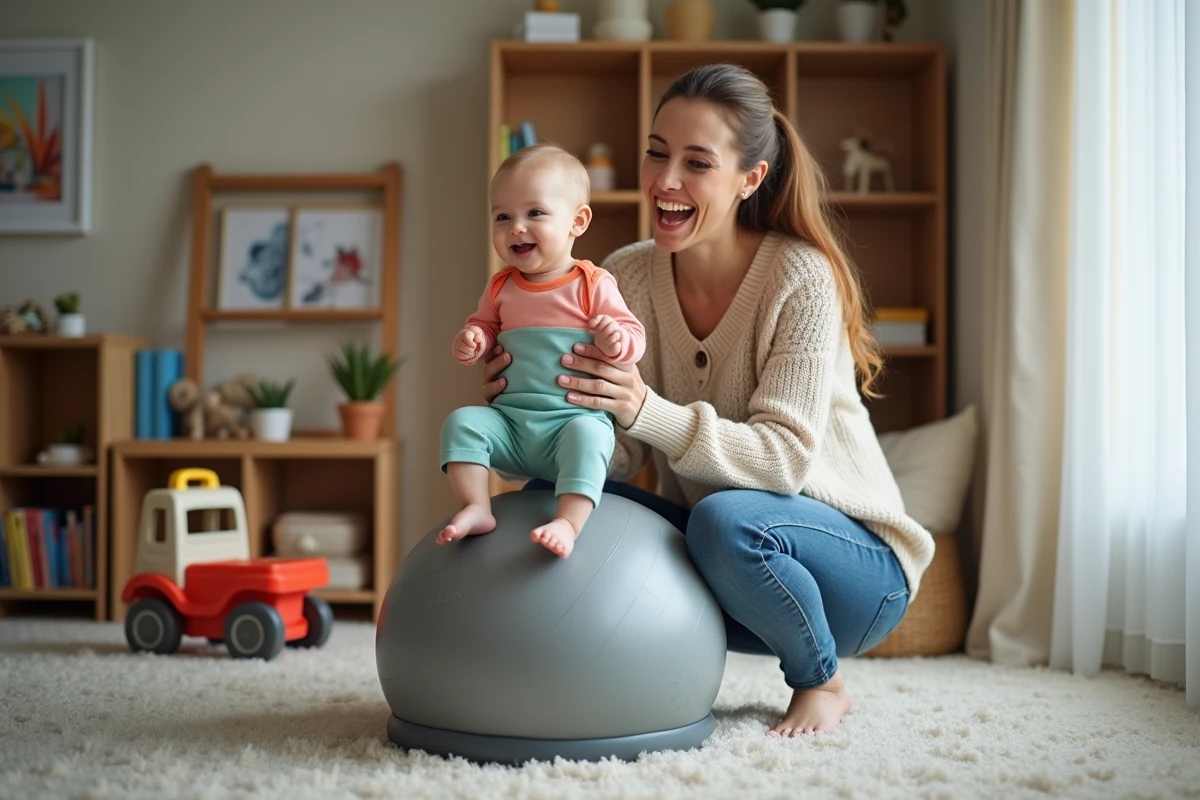
Bouncing on a ball with baby fits into this learning logic. This simple game engages gross motor skills, involves coordination, and captures the young child’s attention. Unlike a walker, which hinders motor independence, here the child truly experiments. With each bounce, they adjust their muscles, test instability, and gradually take ownership of their balance.
Here are some concrete benefits of this playful approach:
- Fine and gross motor skills: each bounce works deep muscles and hand-eye coordination.
- Sensory awakening: variations in movement, rhythm, and support enrich the bodily experience.
- Autonomous development: the child explores freely, building their own motor markers without hindrance.
Psychomotricity is not limited to walking or a specific game: it permeates the entire progression of the child, from the ground to their first confident steps.
How playing with a ball becomes an ally to stimulate baby’s motor development?
Playing with a ball from early childhood opens up a whole world of exploration. Whether it’s rolling a ball, catching a small sphere, or bouncing on an appropriate ball, every gesture engages the whole body. The child uses their muscles, refines their hand-eye coordination, and develops their sense of space. This seemingly innocuous game builds fine and gross motor skills hand in hand.
Catching, throwing, rolling, or bouncing all promote balance. An improvised course with balls encourages the child to move, squat, stand up, and sometimes even walk on tiptoes. These movements, done in pleasure and without pressure, strengthen deep musculature. The child learns to anticipate their actions and to restore their balance spontaneously.
To illustrate the diversity of learning, here are several types of games to integrate:
- Sensory play develops touch and allows for differentiating textures.
- Balance games invite the child to stabilize their body and gain confidence.
- Throwing games train precision, strength, and motor coordination.
Bouncing on a ball also confronts the child with instability, helping them understand their center of gravity and adjust their tone. The child experiments, adjusts, and takes ownership of their body with each movement. This motor journey, built with the adult, prepares and reinforces the confidence needed for walking. Play then becomes a valuable ally, always under the watchful eye of the parent who secures the environment.
Tips and game ideas to support baby on the path to walking with confidence
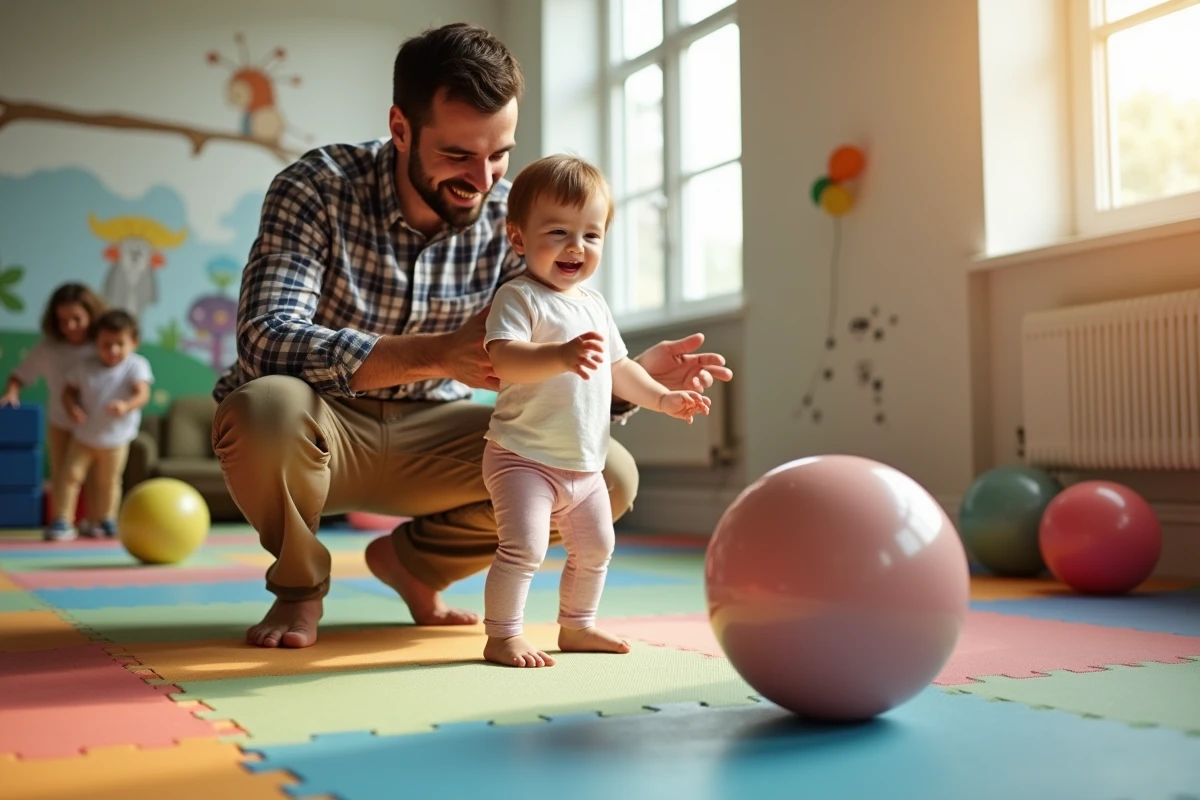
Shared play turns everyday life into a true motor adventure for the young child. On a non-slip mat, they can explore without fear of slipping. The floor then transforms into a field of experimentation, where gradually, they gain confidence in their abilities, inch by inch. Adults, both parents and grandparents, play a discreet but decisive role: guiding, encouraging, observing, without ever rushing the progression.
To propose challenges suitable for the child, here are some easy-to-set-up activity ideas:
- A cardboard to cross, a soft tunnel to go through, or a small module to climb mobilizes balance and coordination.
- Plastic bottles lined up turn a ball-throwing session into an improvised bowling game.
- The shape sorter encourages hand-eye coordination.
- A large-piece puzzle helps refine fine motor skills.
- A sheet placed on the ground allows, with the adult’s help, to bounce balls in a joyful popcorn game.
- Everyday containers become targets to aim at or supports for transferring, stimulating gesture precision.
Another exercise: transporting a ball using a spoon from one point to another to strengthen stability and attention. By adapting the motor course to the child’s age and abilities, we help them progress at their own pace. With these games, walking is prepared in joy, confidence, and companionship. And when the little one finally takes the plunge, a whole world opens up to them, a milestone crossed on the path to independence.