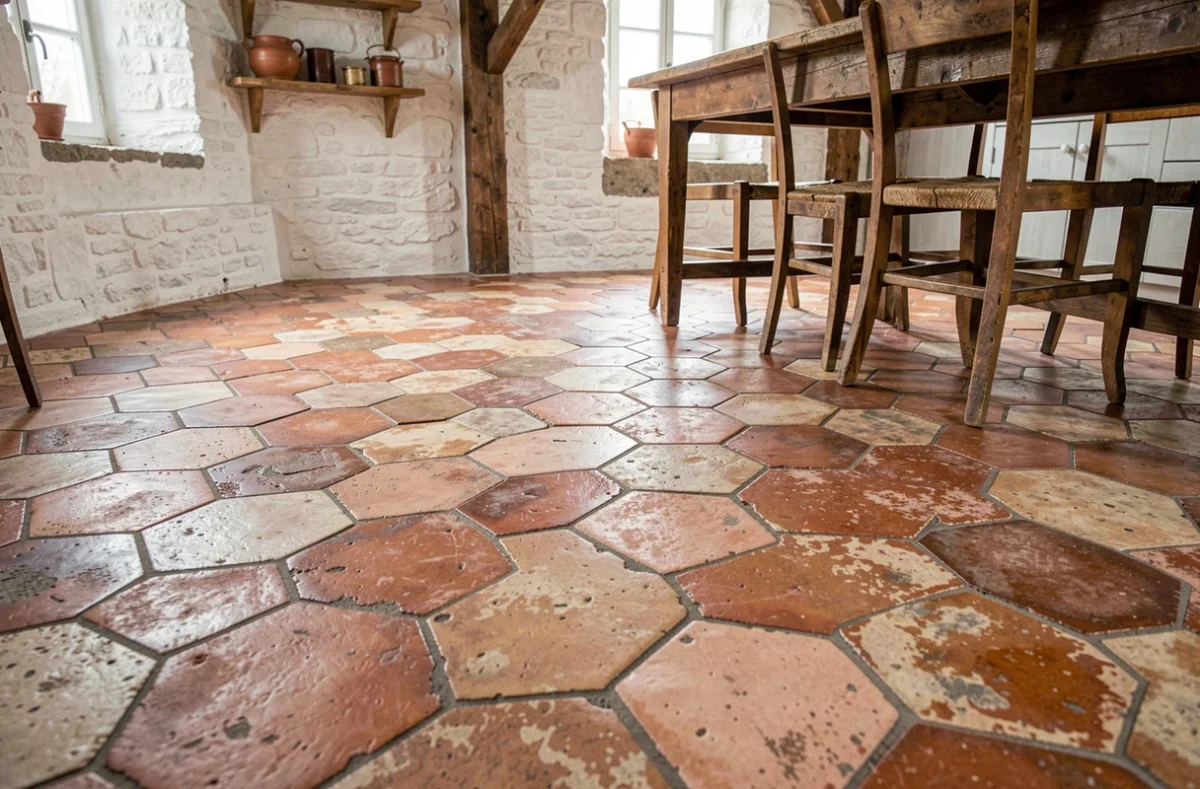
The tomette is a unglazed terracotta tile, shaped from local clay and then fired at high temperatures. Its hexagonal shape, the most common, and its shades ranging from orange-red to pale pink make it a distinctive flooring material. This tiling, originating from the south of France, is still used in both the renovation of old buildings and in new construction.
Clay, firing, and porosity: what defines a terracotta tomette
Before choosing a format or color, understanding the material itself helps avoid several installation and maintenance errors. The tomette is a naturally porous product. Unlike porcelain stoneware, it is not vitrified: the clay retains a water absorption capacity after firing that directly influences the choice of substrate, grout, and surface treatment.
This porosity has an often-overlooked advantage in old houses. On a floor laid on a bed of stones or on compacted earth, the tomettes contribute to the moisture exchanges of the building. Covering this type of substrate with a waterproof screed before laying new tomettes can shift moisture towards adjacent walls rather than solving the problem.
The composition of the clay varies from one extraction basin to another, which explains the differences in hue between a Provençal tomette (deep red, ferruginous clay) and a tile from the Southwest (lighter shades, sometimes pinkish). The temperature and duration of firing also play a role: a longer firing produces a denser, less porous tile, but also a darker one.
For everything you need to know about tomette tiling, these manufacturing parameters determine the tile’s durability as much as its final appearance.
Hexagonal, square, or rectangular tomette: formats and uses
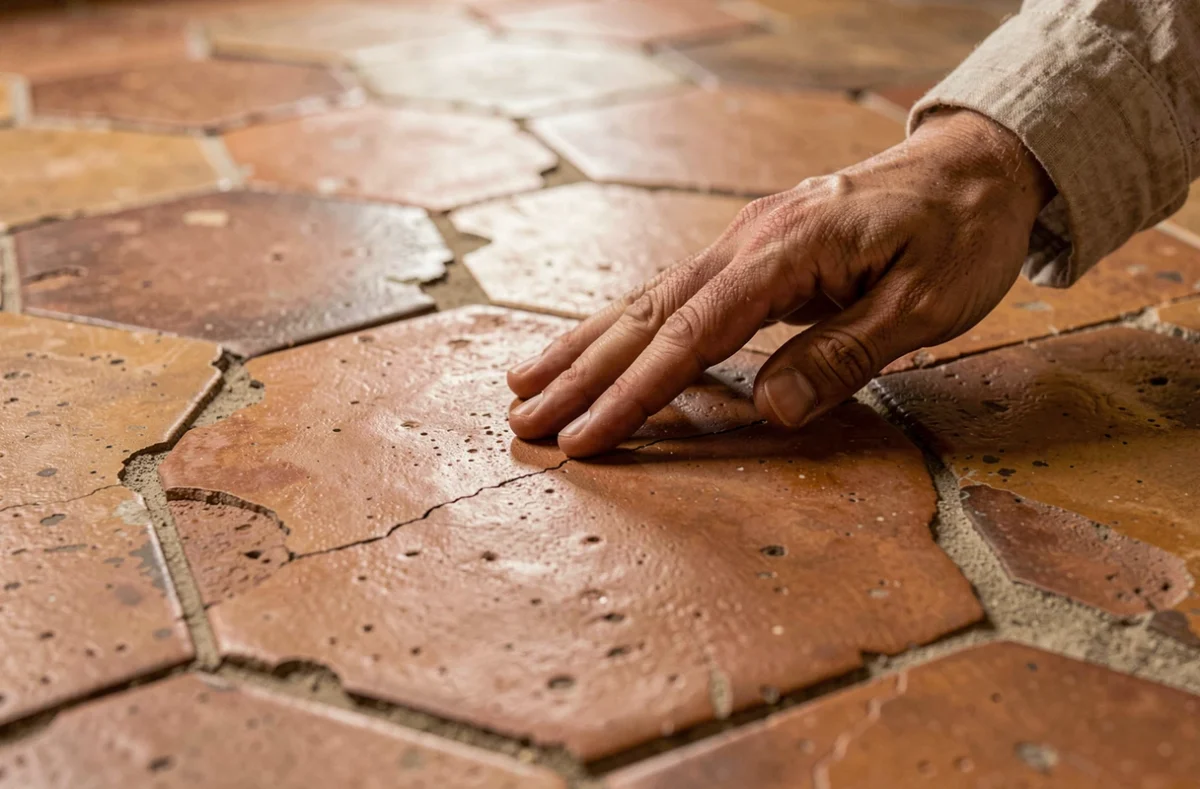
The hexagonal shape remains the historical and most sought-after format. Its staggered paving allows for an even distribution of loads on the floor, which explains its longevity in old buildings. The joints, distributed on six sides, absorb micro-movements of the substrate better than a large square tile.
Other formats exist and are worth considering depending on the project:
- The square tile (often around 15 or 20 cm per side) is suitable for narrow rooms where the hexagon creates a busy optical effect.
- The rectangular tomette, sometimes called “brick,” can be laid in herringbone or staggered patterns and recalls the style of bastide floors.
- Octagonal formats combined with square cabochons create a more intricate pattern, suitable for entrances or reception areas.
The choice of format alters the number of joints per square meter, thus affecting the amount of mortar needed and the installation time. A small-caliber hexagon multiplies the joints and requires careful planning to avoid unsightly cuts at the wall edges.
Choosing the right substrate and grout for durable tomette tiling
The substrate on which the tomette rests determines its longevity as much as the quality of the tile itself. On an old floor (slab on compacted earth, rubble), lime mortar is preferable to cement grout. Lime offers a certain permeability and mechanical flexibility that accommodates the movements of the substrate without cracking.
Cement grout, which is more rigid and waterproof, is suitable for modern concrete screeds but can pose problems on old structures. If the substrate is recent and waterproof, lime grout alone will not correct a design flaw in the screed: diagnosing the substrate must precede any choice of grout material.
Adhered installation or sealed installation
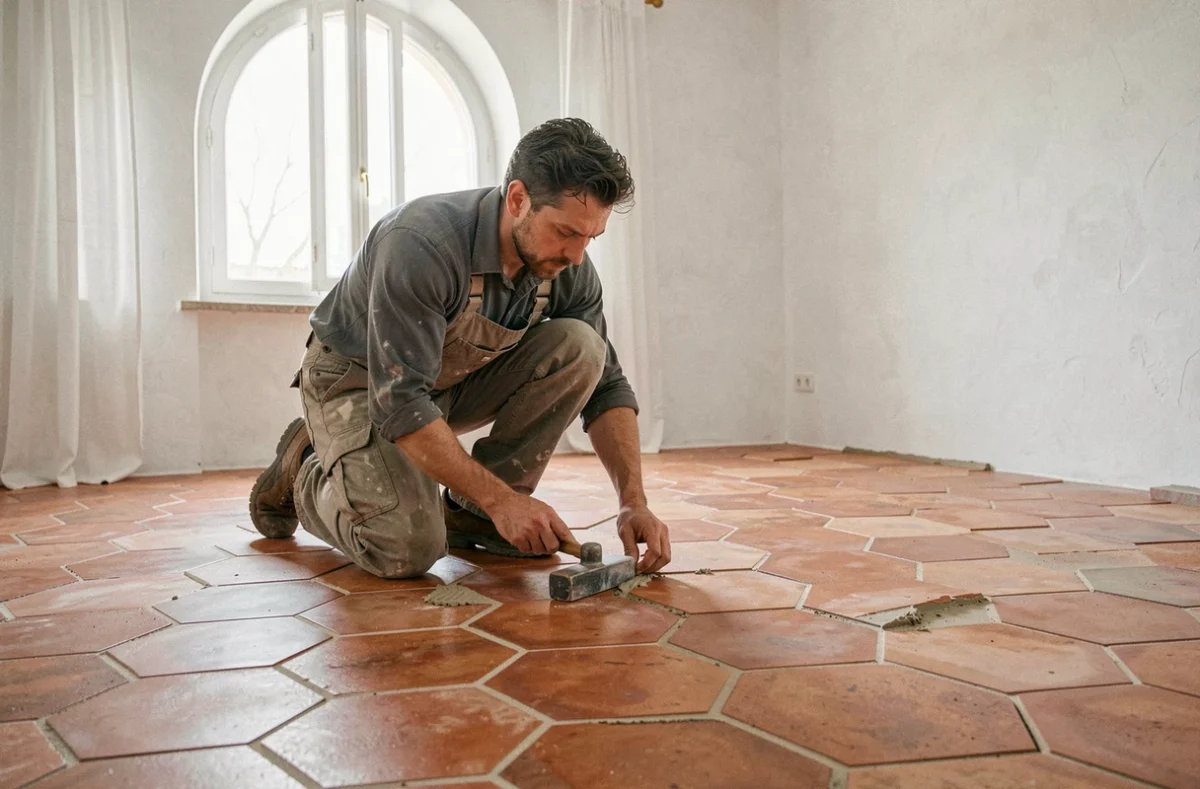
Adhered installation with adhesive mortar is the fastest and most common in new construction. It requires a perfectly flat substrate. Sealed installation on fresh lime screed, which is more technical, is suitable for irregular substrates typical of old buildings. It allows for more leeway to compensate for level differences.
Maintaining the tomette: protect without suffocating the terracotta
Untreated terracotta absorbs liquids and stains easily. Applying a water repellent after installation limits this absorption without altering the appearance of the tile. Some film-forming products (varnishes, resins) give a glossy finish but block water vapor exchanges, which can be problematic in humid rooms or on old floors.
Linseed oil, sometimes recommended to nourish terracotta, significantly darkens the tile’s hue. The effect is irreversible: testing on an isolated tile allows for checking the result before treating the entire surface.
White efflorescence on tomettes
Whitish deposits sometimes appear on the surface of tomettes. This phenomenon, called efflorescence, results from the transport of mineral salts by moisture to the surface of the tile. Before scrubbing or applying an anti-efflorescence product, identifying the underlying cause (moisture from the substrate, overly waterproof screed, capillary rise) is the most reliable approach. Treating the symptom without identifying the source often leads to recurrences.
For regular maintenance, cleaning with clear water or a mild soap is sufficient. Acidic products (vinegar, descalers) attack the surface of the terracotta and should be avoided.
Tomette tiling remains a flooring material whose longevity depends less on the tile than on the substrate and the accompanying treatment. A diagnosis of the existing floor before any tomette purchase helps avoid the most common issues, especially in old houses where moisture circulates according to dynamics that modern materials do not always manage well.